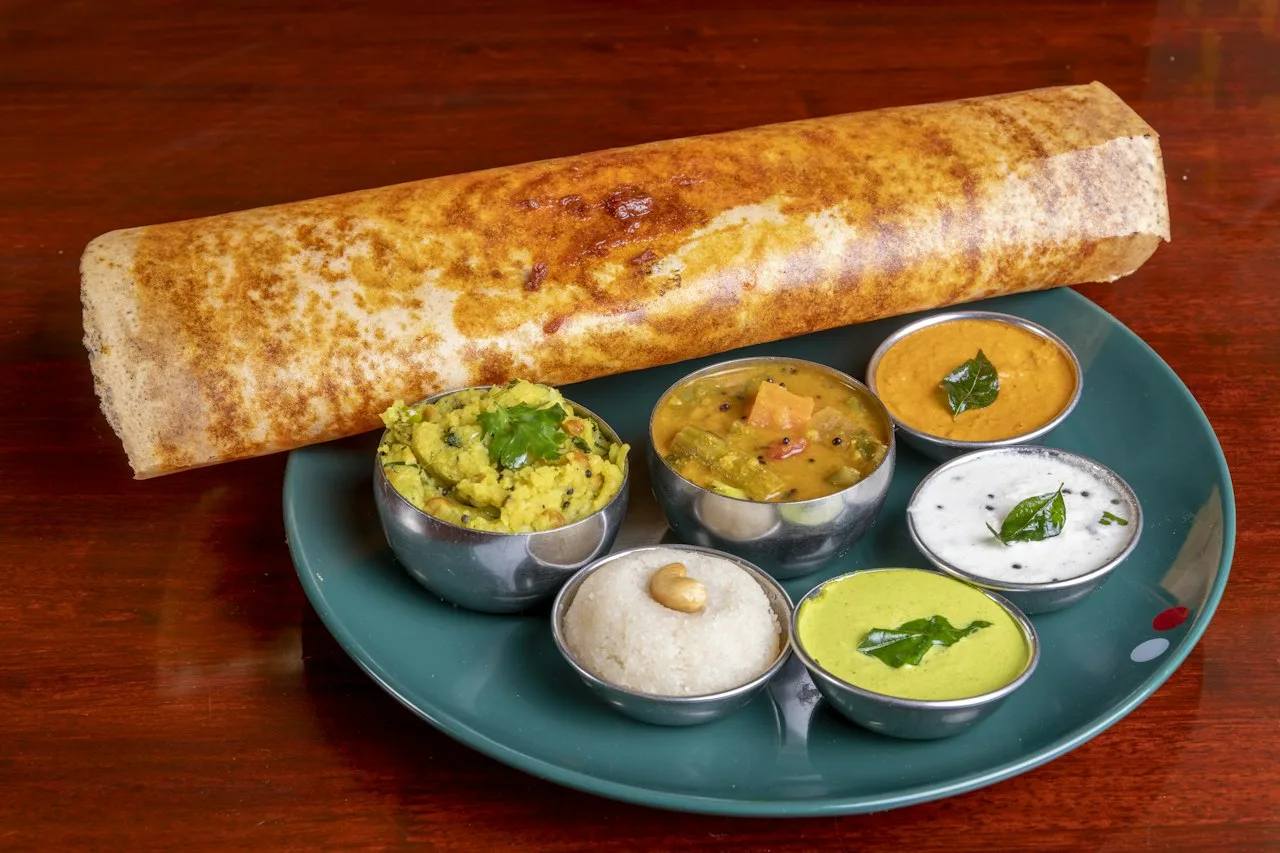
Masala dosa
Incomplete allergen information: some ingredients have not been reviewed yet. Always check the labels before cooking.
- Author
- Equipo Cocinoa
- Preparation time
- 82 min
- Servings
- 4
Summary
South India's thin, crisp pancake: a fermented rice and urad dal batter wrapped around potatoes spiced with mustard seeds and curry leaves. The batter is made the day before; the rest takes under an hour.
Ingredients
- 300 g Rice (idli or parboiled rice, long-grain will do)
- 2 u Onion (thinly sliced)
- 600 g Potato (floury (about 4))
- Salt (to taste)
- 2 u Green Chilli (chopped)
- 6 tablespoons Vegetable Oil (3 for the filling, the rest for cooking the dosas)
- 1 piece Ginger (fresh, about 2 cm, finely chopped)
- 1 handful Coriander (fresh, chopped)
- 1 tablespoon Lemon Juice
- 0.5 teaspoons Turmeric
- 1 teaspoon fenugreek (seeds)
- 1 teaspoon Mustard Seeds (black)
- 500 ml Water (cold, for blending and thinning the batter, roughly)
- 100 g Urad dal (skinned and split (white))
- 1 sprig Curry leaves (fresh (about 15 leaves))
Instructions
Wash the rice and urad dal separately, rubbing them between your fingers, until the water runs almost clear. Soak them in two bowls of plenty of cold water, with the fenugreek in with the dal, for at least 5 hours.
Drain the dal and blend it in a jug blender with the fenugreek, adding cold water a little at a time, until you have a very smooth, white, fluffy paste. Transfer to a large bowl.
8 min
Drain the rice and blend it with water to an almost smooth paste that feels only slightly gritty between your fingers. Add it to the dal with a teaspoon of salt.
8 min
Mix the two pastes together with your hand for a few seconds (the warmth of your skin helps start the fermentation). The bowl should be no more than half full. Cover loosely and leave overnight in a warm place, 8 to 12 hours, until the batter has risen, is bubbly and smells slightly sour.
The next day, make the filling. Boil the potatoes in their skins in salted water until a knife slides in easily. Peel them and crush with a fork, leaving some chunks.
25 min
Heat 3 tablespoons of oil in a frying pan over medium heat and add the mustard seeds. When they start to pop, add the curry leaves, chilli and ginger and stir for a few seconds. Add the onion with a pinch of salt and cook gently until soft and translucent, without letting it colour.
7 min
Stir in the turmeric, potatoes and a splash of water and mix over low heat until everything is an even yellow. Check the salt and finish with the lemon juice and coriander.
4 min
Stir the fermented batter gently, without beating out the air, and add water if needed: it should have the consistency of thick pouring cream that coats the spoon.
Heat a flat cast-iron or non-stick pan over medium-high heat and grease it with kitchen paper dipped in oil. Pour a ladle of batter into the centre and spread it outwards in a spiral with the base of the ladle to make a thin round. Drizzle a few drops of oil around the edge and cook without turning until the underside is golden and crisp and the edges lift. Before each dosa, sprinkle the pan with a few drops of water and wipe it with the paper to take the edge off the heat.
30 min
Put two tablespoons of filling in the centre of each dosa, fold or roll it up and serve straight away.
Notes
Dosa is breakfast and teatime food all over South India, and the potato-filled version was popularised by the restaurants of Udupi, in Karnataka. It is served with coconut chutney (grated coconut blended with green chilli and ginger, topped with mustard seeds and curry leaves fried in oil) and sambar, a brothy lentil and vegetable stew soured with tamarind. Idli rice or parboiled rice is ideal; ordinary long-grain rice gives slightly less crisp dosas. Fenugreek helps the fermentation and gives a golden colour. If your kitchen is cold, ferment the batter in the switched-off oven with the light on; in summer 8 hours may be enough. Leftover batter keeps for 3 days in the fridge and gets tangier; the filling keeps for 2 days. Many families add a pinch of asafoetida to the tempering, but check the label if you are cooking gluten-free, as it is usually cut with wheat flour. Cooking the dosas in ghee gives a lovely aroma, though they are then no longer vegan. The usual mistake is the pan: too hot and the batter sets before you can spread it; too cool and it sticks.
More information
Guide indicatorsDifficulty, quality and data reliability
Guide indicators
- Estimated difficulty72/100
- Recipe completeness60/100
- Nutrition reliability
- Medium
Calculated automatically from the ingredients, steps, time and community feedback. They are not a guarantee.
StorageIndian
I made this
Have you made it? Tell us how it went.
Community versions
Would you change something? Publish your version: it will link back to this recipe.
Comments
Log in to leave a comment.
No comments yet
Be the first to comment on this recipe.