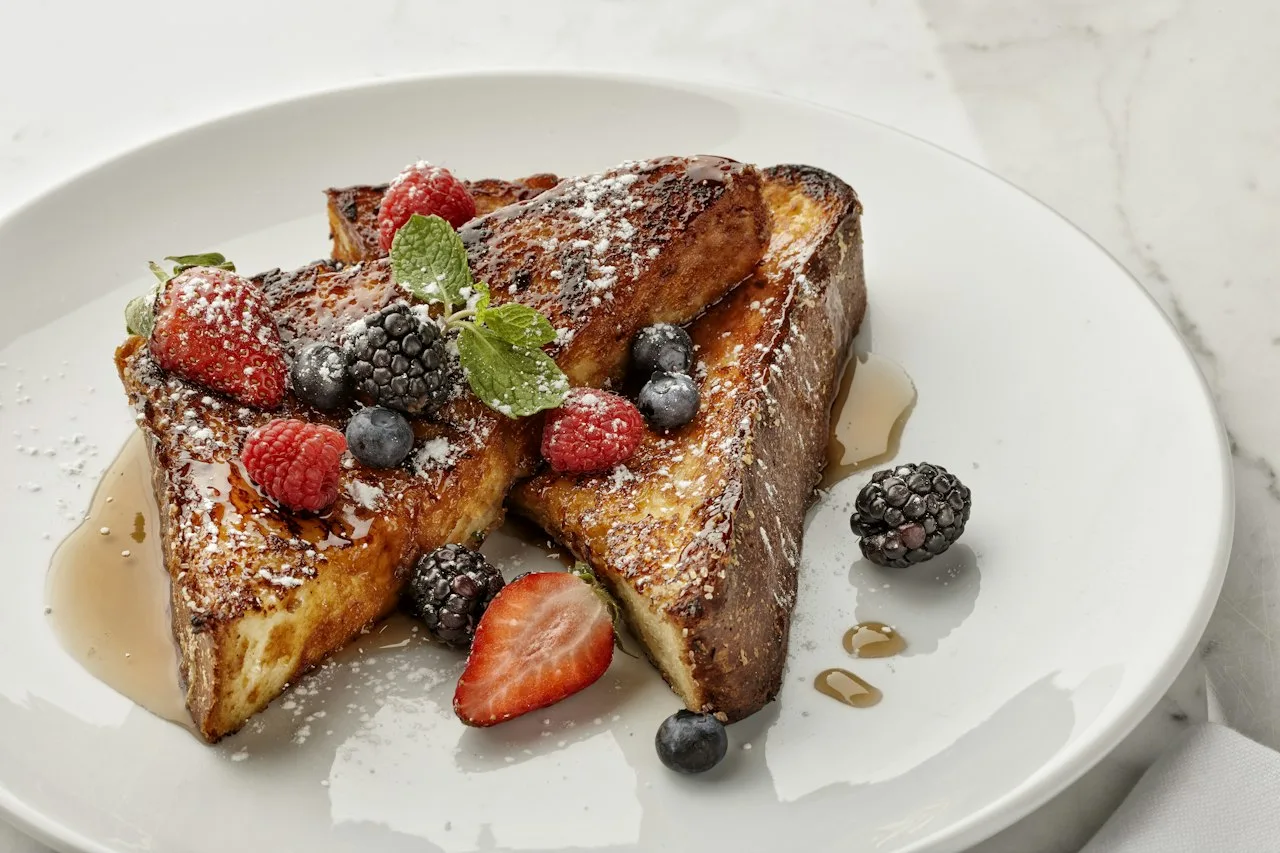
French toast
Tostadas francesas
Contains allergens
- Author
- Equipo Cocinoa
- Preparation time
- 25 min
- Servings
- 4
Summary
Pain perdu as French families make it: slices of day-old bread soaked in egg beaten with milk and browned in butter, soft inside and caramelised outside. A ten-minute breakfast that uses up leftover bread.
Ingredients
- 40 g Butter (for the pan)
- 3 u Egg
- 1 pinch Salt
- 3 tablespoons Sugar (2 for the egg mixture and 1 for caramelising)
- 0.5 teaspoons Cinnamon (ground) (optional)
- 1 teaspoon Vanilla Extract (optional)
- Maple Syrup (or honey and fresh fruit, to serve)
- 250 ml Whole Milk
- 8 slices Stale bread (a day old (baguette, country loaf or thick sandwich bread), about 2 cm thick)
Instructions
If the bread is still soft, leave the slices out for an hour or dry them in the oven at 150 °C for 5 minutes: dry bread soaks up the mixture without breaking.
In a shallow dish, whisk the eggs with the milk, 2 tablespoons of sugar, the vanilla, cinnamon and salt until no streaks of white remain.
2 min
Soak the slices in batches, about 20 seconds per side for baguette or a country loaf (a little less for sandwich bread), until soaked through to the centre but not falling apart. Let them drip for a few seconds on a rack or plate.
5 min
Melt a knob of butter in a non-stick frying pan over medium heat. When it stops foaming, add as many slices as will fit without touching and cook for 2 to 3 minutes per side until golden. If liquid still seeps out when you press the centre with a spatula, lower the heat and give them another minute.
12 min
For a caramelised finish, sprinkle a little of the remaining sugar over the top, flip the slices and leave for half a minute, until the sugar melts and turns glossy. Repeat with the rest of the bread, adding fresh butter for each batch, and keep the cooked slices warm in the oven at 100 °C while you finish.
6 min
Serve straight away with maple syrup, or with honey and fresh fruit.
Notes
Pain perdu means 'lost bread': it was invented to rescue bread that would otherwise be thrown away, which is why it works best with dry bread that soaks up the mixture without falling apart. It is not the same as the Spanish torrija: there is no syrup and no frying in lots of oil, just a single egg and milk mixture and a quick cook in butter, and it is eaten hot, straight from the pan. The most common mistake is too much heat: the outside burns before the egg in the middle sets; over medium heat it turns golden with a custardy centre. Brioche or milk bread gives a softer, more dessert-like result (the French call it pain perdu brioché): soak it for just a few seconds. You can swap the whole milk for semi-skimmed or a plant-based drink, and the vanilla for grated orange zest. To get ahead, whisk the mixture the night before and keep it in the fridge. Leftovers keep for a day in the fridge; cooked slices also freeze well between sheets of baking paper and reheat in the toaster or in the oven at 180 °C.
More information
Nutrition facts358 kcal per serving
Nutrition facts
- Protein13 %12 g
- Carbs47 %42 g
- Fat40 %16 g
The percentage shows how much of the calories each macronutrient provides.
| Nutrient | Per serving | Per 100 g |
|---|---|---|
| Calories | 358 kcal | 200 kcal |
| Protein | 12 g | 6.7 g |
| Carbs | 42 g | 23.5 g |
| Fat | 16 g | 8.9 g |
One serving is about 179 g of raw ingredients; values per 100 g are based on that weight.
Estimated from the ingredient list · Values may vary depending on cooking method and product brand.
Guide indicatorsDifficulty, quality and data reliability
Guide indicators
- Estimated difficulty37/100
- Recipe completeness65/100
- Nutrition reliability
- Medium
Calculated automatically from the ingredients, steps, time and community feedback. They are not a guarantee.
StorageKeeps 1 day in the fridge
I made this
Have you made it? Tell us how it went.
Seasonal recipes, every Friday
One email a week (in Spanish) with what's in season, the monthly challenge and three recipes to try. No account needed.
We'll ask you to confirm by email, and you can unsubscribe with one click. Privacy
Community versions
Would you change something? Publish your version: it will link back to this recipe.
Comments
Log in to leave a comment.
No comments yet
Be the first to comment on this recipe.