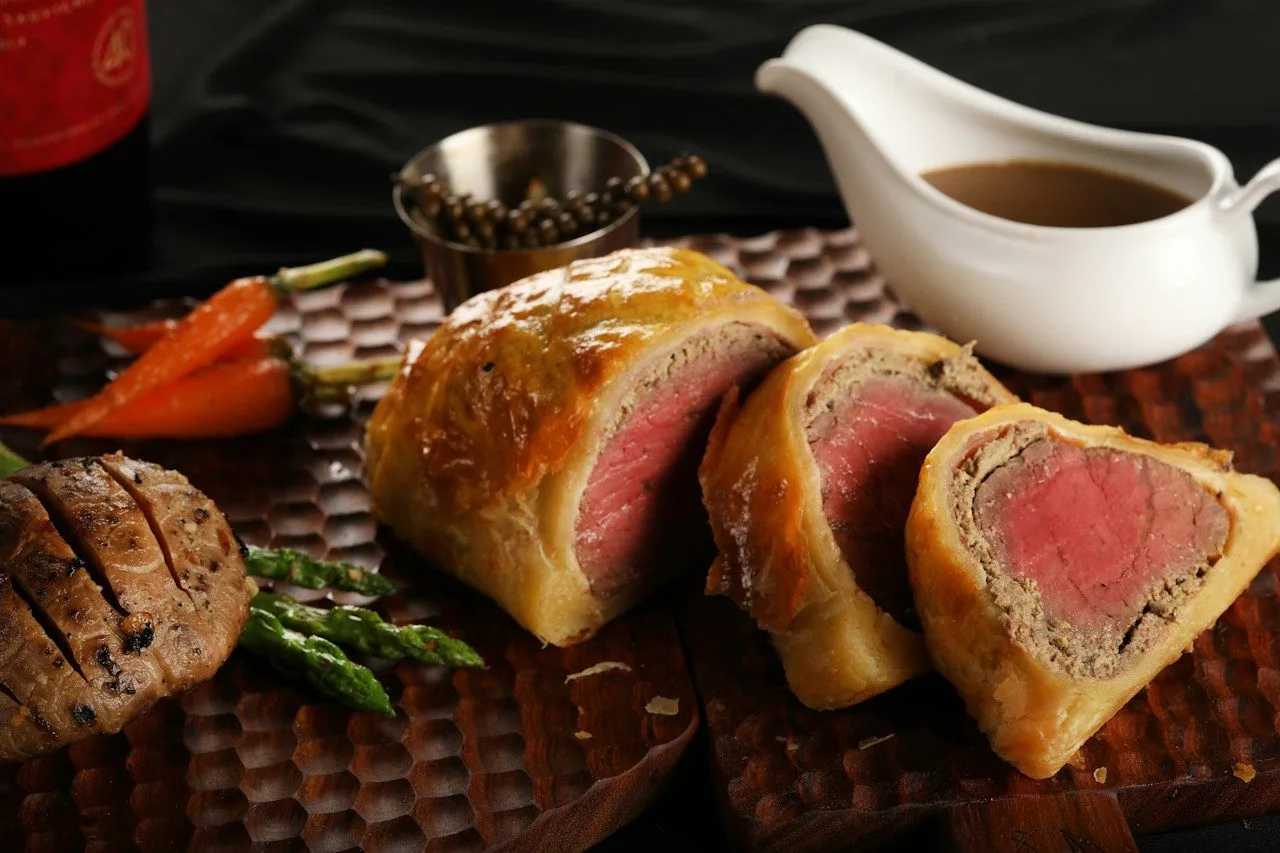
Beef Wellington
Solomillo Wellington
Contains allergens
- Author
- Equipo Cocinoa
- Preparation time
- 3 hr
- Servings
- 6
Summary
A challenging recipe for 6 servings. It takes about 175 minutes to make. Each serving has about 1012 kcal. It is nut-free.
The great British showpiece: a seared beef fillet coated in mushroom duxelles and slices of cured ham, wrapped in puff pastry and baked until the pastry is golden and crisp and the beef is pink and juicy inside.
Ingredients
- 1 tablespoon Wheat flour (for dusting)
- 30 g Butter
- 1 u Egg (beaten with a pinch of salt, for glazing)
- 2 cloves Garlic (chopped)
- Salt (to taste)
- Black pepper (freshly ground, to taste)
- 2 tablespoons Sunflower Oil
- 4 sprigs Thyme (fresh, leaves only)
- 500 g Puff Pastry (all-butter, in a block or two rectangular sheets)
- 50 ml Dry sherry (optional)
- 2 u Shallots (very finely chopped)
- 1 kg Beef Fillet (centre-cut, even thickness, trimmed of sinew)
- 2 tablespoons Dijon Mustard (or English mustard)
- 10 slices Serrano Ham (very thinly sliced (about 150 g), or prosciutto)
- 1 u Egg yolk (for a deeper glaze) (optional)
- 1 pinch Cast salt (for the top) (optional)
- 600 g Button mushroom (or a mix of button and chestnut mushrooms)
Instructions
Take the beef out of the fridge half an hour beforehand. Pat it dry with kitchen paper, tie it with string every 3 cm if it is not an even thickness, and season with salt and pepper. Heat the oil in a large frying pan over very high heat and sear the beef on all sides, ends included, about 1 minute per side, until well browned. Transfer to a rack, remove the string and, while still hot, brush it all over with the mustard. Leave to cool.
10 min
For the duxelles, chop the mushrooms very finely, by hand or in short pulses in a food processor, in batches, without turning them into a purée. Melt the butter in a wide frying pan over medium heat, soften the shallots and garlic for 3 minutes, then add the mushrooms and thyme leaves. Cook over medium-high heat, stirring, until they release all their liquid and it has completely evaporated: the mixture should be a dry paste that comes away from the pan. Add the sherry, if using, and let it bubble away. Season, then spread the duxelles out on a plate to cool completely.
25 min
Lay two overlapping sheets of cling film on the worktop, about 50 × 40 cm. Arrange the ham slices on top, slightly overlapping, to make a rectangle large enough to wrap the beef. Spread the cold duxelles over it in a thin, even layer, place the beef along the edge nearest you and roll it up tightly using the film to help. Twist the ends of the film like a sweet wrapper to shape it into a neat cylinder and chill for at least 30 minutes, or until the next day.
40 min
Dust the worktop with flour and roll the pastry into a rectangle about 3 mm thick, large enough to wrap the roll (if using two sheets, overlap them by 2 cm, brush the join with egg and press together). Unwrap the roll, place it along one edge of the pastry, brush the edges with egg and wrap it so the pastry overlaps by only 2 cm underneath; trim off the excess so there are no double layers, which stay raw. Fold the ends like a parcel, trimming the excess there too, and set the Wellington seam-side down on baking paper. Chill for 20 minutes.
30 min
Meanwhile, preheat the oven to 220 °C, top and bottom heat, with a baking tray inside on a low shelf. Brush the Wellington with the beaten egg (mixed with the yolk if you want a deeper shine), wait 5 minutes and give it a second coat. Score a pattern with the back of a knife without cutting through the pastry, make two or three small holes on top to let the steam out and sprinkle with flaky salt.
10 min
Slide the Wellington on its paper onto the hot tray and bake for 20 minutes. Lower the oven to 200 °C and keep baking until the pastry is deep golden and a thermometer pushed into the centre of the thickest part reads 46-48 °C, another 15 to 20 minutes. If it browns too quickly, cover it loosely with foil.
40 min
Transfer it to a rack and leave it to rest, uncovered, for 10 to 15 minutes: the inside will keep rising to 52-54 °C and the juices will settle, so they will not run out when you slice it.
15 min
Slice with a serrated knife into 2 to 3 cm slices, using a gentle sawing motion without pressing down, and serve straight away.
5 min
Notes
Beef Wellington is the showpiece of British cooking at Christmas and on special occasions. The name is usually credited to the Duke of Wellington, the victor of Waterloo, though there is no evidence he ever ate it; the recipe as we know it became popular in the 20th century, in Britain and the United States. It looks daunting, but it is a series of simple steps and nearly all of it can be done ahead: the day before, sear the beef, make the duxelles and roll everything up in the ham with cling film; on the day, all that is left is wrapping it in pastry and baking it. A probe thermometer is your best friend, because the beef keeps cooking from its own stored heat as it rests and rises by 5 to 7 °C, so it has to come out of the oven before it reaches the doneness you want. For pink and juicy medium-rare, take it out at 46-48 °C and after resting it will be at 52-54 °C; if you like it more cooked, take it out at 54 °C and it will end up around 60 °C. The great enemy is a soggy bottom: the duxelles must be cooked down to a dry paste, everything must be cold before you assemble it, the ham acts as a barrier against moisture, and the preheated baking tray starts cooking the base from the first minute. Some cooks add a layer of thin crêpes between the ham and the pastry, which soaks up even more juice. Very thinly sliced serrano ham is a perfect stand-in for prosciutto, and all-butter puff pastry has the best flavour. Serve it with a red wine sauce or gravy, roast potatoes and green vegetables. Leftovers keep for 2 days in the fridge and can be reheated in the oven at 180 °C for about 12 minutes, though the beef will cook a little further; it is best not frozen, raw or baked, as the pastry turns soggy when it thaws.
More information
Nutrition facts1012 kcal per serving
Nutrition facts
- Protein17 %44 g
- Carbs18 %46 g
- Fat64 %72 g
The percentage shows how much of the calories each macronutrient provides.
| Nutrient | Per serving | Per 100 g |
|---|---|---|
| Calories | 1,012 kcal | 255 kcal |
| Protein | 44 g | 11.1 g |
| Carbs | 46 g | 11.6 g |
| Fat | 72 g | 18.1 g |
One serving is about 397 g of raw ingredients; values per 100 g are based on that weight.
Estimated from the ingredient list · Values may vary depending on cooking method and product brand.
Guide indicatorsDifficulty, quality and data reliability
Guide indicators
- Estimated difficulty78/100
- Recipe completeness65/100
- Nutrition reliability
- Medium
Calculated automatically from the ingredients, steps, time and community feedback. They are not a guarantee.
StorageKeeps 2 days in the fridge
Frequently asked questions
- How long does Beef Wellington take to make?
- It takes about 175 minutes in total.
- Which allergens does Beef Wellington contain?
- It contains cereals containing gluten, milk, eggs, sulphites and mustard. Always check the labels of the products you use.
- How long does Beef Wellington keep in the fridge?
- Up to 2 days in the fridge, in a closed container.
- How many calories does Beef Wellington have?
- About 1012 kcal per serving, with 44 g of protein, 46 g of carbohydrates and 72 g of fat. This is an estimate worked out from its ingredients.
- Which diets is this recipe suitable for?
- It is nut-free.
I made this
Have you made it? Tell us how it went.
Seasonal recipes, every Friday
One email a week (in Spanish) with what's in season, the monthly challenge and three recipes to try. No account needed.
We'll ask you to confirm by email, and you can unsubscribe with one click. Privacy
Community versions
Would you change something? Publish your version: it will link back to this recipe.
Comments
Log in to leave a comment.
No comments yet
Be the first to comment on this recipe.