Duck Confit
Contains allergens
Incomplete allergen information: some ingredients have not been reviewed yet. Always check the labels before cooking.
- Author
- TheMealDB
- Preparation time
- Flexible
- Servings
- 7 (estimated)
Nutrition facts
- Protein11 %19 g
- Carbs1 %1 g
- Fat88 %65 g
The percentage shows how much of the calories each macronutrient provides.
| Nutrient | Per serving | Per 100 g |
|---|---|---|
| Calories | 677 kcal | 376 kcal |
| Protein | 19 g | 10.6 g |
| Carbs | 1 g | 0.6 g |
| Fat | 65 g | 36.1 g |
One serving is about 180 g of raw ingredients; values per 100 g are based on that weight.
Estimated from the ingredient list · Values may vary depending on cooking method and product brand.
Guide indicators
- Estimated difficulty21/100
- Recipe completeness45/100
- Nutrition reliability
- High
Calculated automatically from the ingredients, steps, time and community feedback. They are not a guarantee.
Source: TheMealDB · Licence: TheMealDB public API (test key) · Recipe data provided by TheMealDB (www.themealdb.com).
Summary
Miscellaneous - France
Ingredients
- 4 cloves Garlic
- 100 ml White wine
- handfuls Thyme
- 4 Bay Leaf
- handfuls Sea Salt
- 4 Duck Legs
Instructions
The day before you want to make the dish, scatter half the salt, half the garlic and half of the herbs over the base of a small shallow dish. Lay the duck legs, skin-side up, on top, then scatter over the remaining salt, garlic and herbs. Cover the duck and refrigerate overnight. This can be done up to 2 days ahead.
Pour the wine into a saucepan that will snugly fit the duck legs in a single layer. Brush the salt off the duck legs and place them, skin-side down, in the wine. Cover the pan with a lid and place over a medium heat. As soon as the wine starts to bubble, turn the heat down to the lowest setting and cook for 2 hours, checking occasionally that the liquid is just barely simmering. (If you own a heat diffuser, it would be good to use it here.) After 2 hours, the duck legs should be submerged in their own fat and the meat should feel incredibly tender when prodded. Leave to cool.
The duck legs are now cooked and can be eaten immediately – or you can follow the next step if you like them crisp. If you are preparing ahead, pack the duck legs tightly into a plastic container or jar and pour over the fat, but not the liquid at the bottom of the pan. Cover and leave in the fridge for up to a month, or freeze for up to 3 months. The liquid you are left with makes a tasty gravy, which can be chilled or frozen until needed.
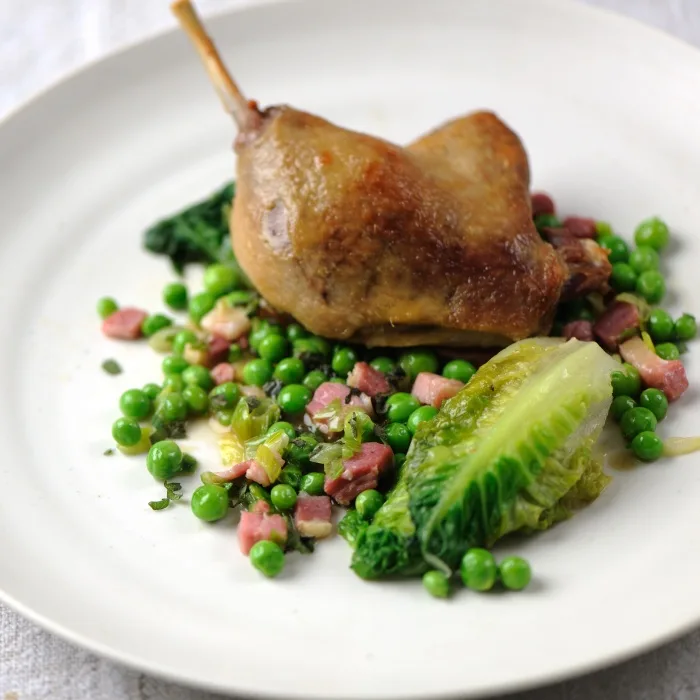
To reheat and crisp up the duck legs, heat oven to 220C/fan 200C/gas 7. Remove the legs from the fat and place them, skin-side down, in an ovenproof frying pan. Roast for 30-40 mins, turning halfway through, until brown and crisp. Serve with the reheated gravy, a crisp salad and some crisp golden ptoatoes.
Videos and links
YouTube· from a similar recipe
How to cook a delicious Duck Ragu (open on YouTube)Third-party content linked to its creators. The Cocinoa recipe is the one on this page.
Comments
Log in to leave a comment.
No comments yet
Be the first to comment on this recipe.