Bavarian pretzels
Pretzels bávaros
Contains allergens
Incomplete allergen information: some ingredients have not been reviewed yet. Always check the labels before cooking.
- Author
- Equipo Cocinoa
- Preparation time
- 4 hr
- Servings
- 8
Summary
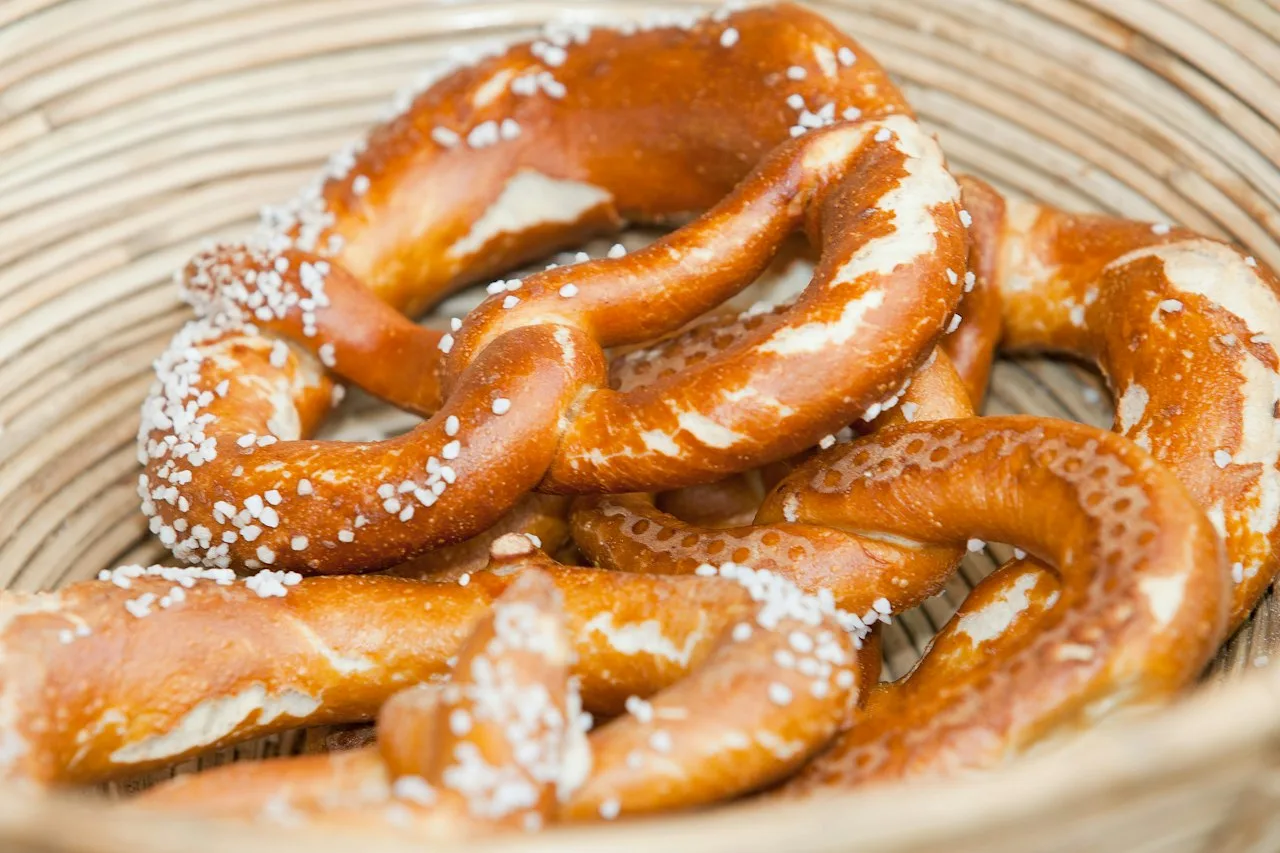
Laugenbrezel like the ones from Munich bakeries: a firm dough, thin crisp arms, a thick belly that bursts open in the oven and that glossy, dark crust with coarse salt. Made with a baked bicarbonate of soda bath, which is safe to use at home.
Ingredients
- 500 g Wheat flour (medium-strength bread flour)
- 25 g Butter (softened)
- 10 g Salt (fine, for the dough)
- 75 g Bicarbonate Of Soda (for the bath, baked first (step 1))
- 20 g Yeast (fresh, or 7 g dried yeast)
- 2 tablespoons Coarse Salt (pretzel salt (Brezelsalz) or coarse flaky salt)
- 1.8 l Water (280 ml lukewarm for the dough and 1.5 litres for the bath)Original: 1780 ml
Amounts are shown in your preferred measurement system; conversions are approximate and the original recipe is kept.
Instructions
Make the baked bicarbonate: spread it on a tray lined with baking paper and bake for 1 hour at 150 °C. It will lose about a third of its weight. Leave it to cool and store it in a closed, labelled jar; you can do this days in advance.
60 min
Crumble the yeast into 280 ml of lukewarm water. Mix the flour and salt in a bowl, add the yeasted water and the butter and knead for about 10 minutes into a smooth, firm dough that does not stick at all. It is much stiffer than an ordinary bread dough, and that is how it should be: don't add more water.
12 min
Cover and leave to rest for 30 minutes. It does not need to double in size, just relax and start to ferment.
30 min
Divide the dough into 8 pieces of about 100 g, shape each into a short log and leave covered for 10 minutes so the gluten relaxes.
10 min
On an unfloured worktop, roll each piece under your palms, working from the centre outwards, into a rope about 60 cm long, thick in the middle (the belly) and very thin at the ends (the arms). If the dough shrinks back, let it rest for a few minutes and carry on.
10 min
To shape, lay the rope in a U with the belly towards you and the ends pointing away. Take one end in each hand, cross them twice to make a twist in the middle, then bring them down onto the belly and press them on at either side, leaving the tips sticking out slightly. Transfer to a tray lined with baking paper.
10 min
Leave uncovered for 20 minutes at room temperature, then for 30 minutes in the fridge, still uncovered. This forms a dry, firm skin that survives the bath without losing its shape.
50 min
Preheat the oven to 220 °C, conventional heat. Bring 1.5 litres of water to the boil in a wide stainless steel pan, add the baked bicarbonate a little at a time, as it fizzes, and lower the heat to a gentle simmer.
10 min
Lower the pretzels into the bath one or two at a time for about 30 seconds, turning them halfway. Lift them out with a slotted spoon, keeping your hands out of the water, let them drain and place them well apart on a tray lined with fresh baking paper.
10 min
With a very sharp knife or a razor blade, make a horizontal cut about 1 cm deep across the thick part of the belly and sprinkle with the coarse salt.
3 min
Bake for 15 to 18 minutes until a deep, glossy brown. Do not take them out when they are merely golden: the dark colour is part of the flavour.
16 min
Leave to cool on a wire rack for 10 minutes and serve freshly baked, with butter, sweet mustard or Obatzda.
10 min
Notes
The Laugenbrezel is the defining bread of Bavaria and Swabia: its mahogany colour, thin shiny skin and unmistakable flavour all come from an alkaline bath before baking. German bakeries use food-grade lye (sodium hydroxide) diluted to 3-4 %, which gelatinises the surface and drives the browning. At home, the safe alternative is baked bicarbonate of soda: heating it for an hour turns it into sodium carbonate, which is considerably more alkaline than ordinary bicarbonate, and the result comes very close to the original. Unbaked bicarbonate works too, but the pretzels come out paler and less flavourful. Even so, sodium carbonate irritates skin and eyes: don't handle it with wet hands, keep it in a labelled jar and use a stainless steel pan, never aluminium. If you decide to use lye, it must be food grade and you should treat it as what it is, a corrosive chemical: wear gloves and goggles, always make the solution cold and in a glass or stainless steel container, add the lye to the water and never the other way round, keep children and pets away and bake on baking paper, as it attacks aluminium. Once baked, the coating is no longer dangerous. The Bavarian shape has a thicker belly that bursts open rustically and arms joined lower down; the Swabian one has very thin arms set higher up and a cleanly scored belly. In Munich they are eaten at the Weißwurst breakfast, with the white veal sausage and sweet mustard, and in beer gardens with Obatzda, a spread of Camembert, butter, onion and paprika. They are at their best on the day: don't keep them in the fridge or in a plastic bag, as the salt dissolves and the crust goes soft. If you are freezing them, do it before salting; later, dampen them, add the salt and warm them for 5 minutes in the oven at 180 °C.
More information
Guide indicatorsDifficulty, quality and data reliability
Guide indicators
- Estimated difficulty71/100
- Recipe completeness60/100
- Nutrition reliability
- High
Calculated automatically from the ingredients, steps, time and community feedback. They are not a guarantee.
StorageKeeps 1 day in the fridge
I made this
Have you made it? Tell us how it went.
Community versions
Would you change something? Publish your version: it will link back to this recipe.
Comments
Log in to leave a comment.
No comments yet
Be the first to comment on this recipe.